The central change is not that SEO has ended. Traditional search remains foundational, but website discovery is expanding into a layered system where search engines, AI answer systems, and agents may crawl, retrieve, interpret, compare, cite, and act on public information.
The practical question is no longer only whether a page ranks. It is also whether the right systems can access it, understand it, verify its claims, and use it as evidence.
The familiar search model
For more than two decades, web visibility followed a pattern most website owners learned to recognise.
A search engine discovered a page, processed its contents, added it to an index, evaluated its relevance and quality, and placed it somewhere in a ranked list. A person scanned the results, selected a link, and visited a website.
Google still describes Search through the broad stages of crawling, indexing, and serving results. That foundation matters because a page normally has to be technically accessible and interpretable before relevance or quality can be evaluated.
The original visibility question was therefore:
Can a search engine discover, index, and rank this page for a useful query?
This led to the durable foundations of search engine optimisation:
- crawlable navigation and internal links;
- descriptive titles and headings;
- useful page copy;
- relevant links and authority signals;
- understandable URLs;
- reliable performance and mobile usability;
- clear index and canonical directives.
The search engine acted primarily as an intermediary between a question and a set of documents. Its job was to rank likely destinations. The person remained responsible for opening several pages, comparing claims, and constructing an answer.
That model still exists. It remains commercially important. But it is no longer the only discovery journey.
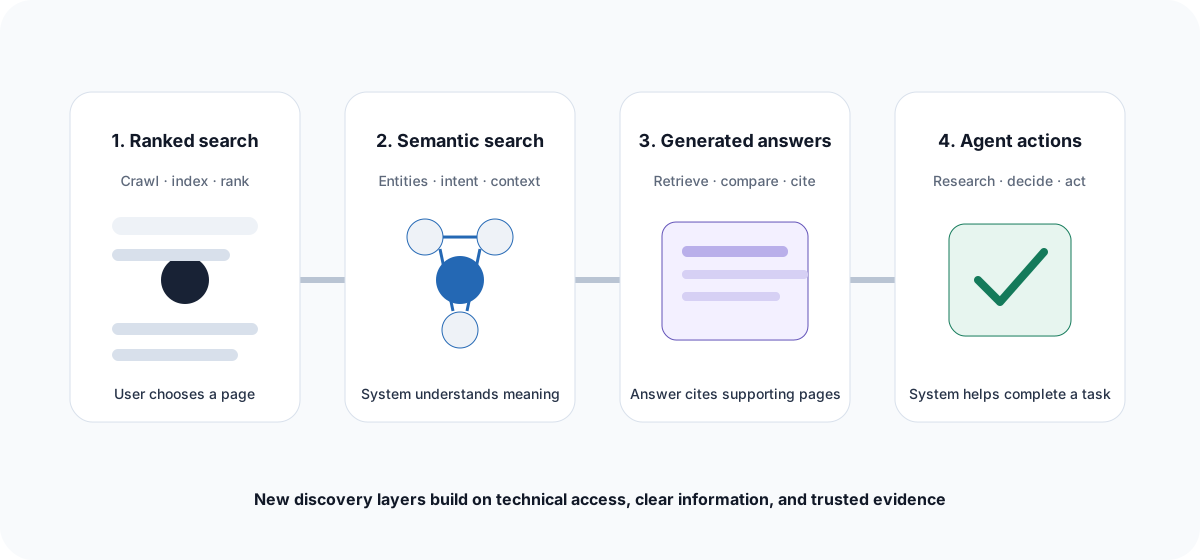
From keywords to meaning
As the web grew, matching literal words became insufficient.
Search systems increasingly had to interpret entities, relationships, topics, location, intent, content type, and the meaning of a page beyond exact keyword repetition. Structured data became one way publishers could give machines explicit clues about products, organisations, people, events, reviews, articles, and other entities.
This produced richer search experiences:
- knowledge panels;
- featured snippets;
- direct answers;
- local and product results;
- image and video features;
- comparison and recommendation modules.
The important change was conceptual. Search engines were no longer only ranking complete documents. They were also extracting, organising, and presenting information from those documents.
For website owners, visibility started to depend on more than using the right phrase. A page needed to make its subject, entities, relationships, and evidence legible.
This is why clear writing, logical information architecture, descriptive headings, structured data that matches visible content, and consistent organisation details are not merely cosmetic SEO tasks. They help machines establish what a page is about and how it relates to the wider web.
Generated answers change the journey
Large language model interfaces changed the shape of the question.
A person no longer has to compress a need into two or three keywords. They can describe a complete situation:
What is a simple invoice generator for a freelancer in Denmark that does not require an account, keeps invoice data private, supports VAT, and can include a payment QR code?
That request includes a user type, geography, privacy preference, feature requirements, an implicit comparison, and a decision to be made.
A generative search system may interpret the request, explore several subtopics, retrieve candidate sources, extract relevant passages, compare options, and produce one combined response. Google documents query fan-out for its AI search features, where a single question can trigger multiple related searches. OpenAI similarly explains that ChatGPT Search may rewrite a question into one or more targeted queries.
The user may then receive:
- a synthesized explanation;
- a shortlist of products;
- a comparison assembled from several websites;
- supporting citations;
- suggested follow-up questions;
- or an action an agent can help complete.
The system is no longer merely handing the user a list of pages. It is participating in the research and decision process.
Why retrieval matters
A language model’s internal knowledge may be outdated, incomplete, difficult to attribute, or insufficient for a specialised question. Retrieval-augmented generation combines model capabilities with external documents selected at answer time.
The retrieved material can provide:
- recent facts;
- specialised detail;
- primary-source evidence;
- product information;
- provenance and citations.
This gives public web pages another role. They are still destinations for people, but they may also become evidence supplied to a machine while it formulates an answer.
That is the foundation of the citation era.
Important distinction
AI visibility is not one ranking system
Different products may use different crawlers, search indexes, retrieval methods, source-selection rules, model prompts, and interfaces. There is no universal “AI rank” that OpenForBots—or anyone else—can responsibly guarantee.
Traditional SEO remains foundational
The rise of AI answers does not make conventional SEO irrelevant.
Google states that the same SEO fundamentals used for Search continue to apply to AI Overviews and AI Mode. Pages generally need to be indexed and eligible to appear in Search before they can be shown as supporting links. Google does not require a special AI schema or a separate machine-readable file for those features.
That means the familiar work remains important:
- permit appropriate crawling;
- publish important information in accessible text;
- maintain useful internal links;
- provide a good page experience;
- create accurate, original content;
- use structured data only when it matches the visible page;
- establish trust and ownership;
- follow search policies.
The more accurate framing is:
SEO creates the retrieval foundation. AI readiness extends that foundation to new crawlers, answer systems, evidence patterns, and agent interactions.
A website that is inaccessible, thin, confusing, or technically unreliable will not become strong merely by adding an llms.txt file or mentioning “AI” in its headings.
At the same time, a page can perform adequately in conventional search while still being poorly prepared for AI-mediated discovery—for example, if key business facts are hidden behind scripts, claims lack evidence, crawler purposes are misunderstood, or the page cannot supply a concise passage that supports a complex answer.
Discovery, citation, and influence are different outcomes
People often use “AI visibility” as though it describes one event. In practice, several stages have to be separated.
1. Discovery
Can the system find the URL through a crawler, search index, sitemap, link, third-party provider, or user-triggered request?
2. Access
Can the relevant crawler or fetcher retrieve the page?
Access may fail because of robots rules, CDN restrictions, web-application firewalls, bot challenges, authentication, rate limits, JavaScript-only output, or server errors.
OpenAI distinguishes OAI-SearchBot, used for search visibility, from GPTBot, associated with potential model training. Perplexity similarly documents separate search and user-triggered agents. Crawler identity and purpose therefore matter.
3. Retrieval
Does the system select the page as a useful candidate for the current question?
A publicly accessible page is not automatically retrieved. Selection may depend on relevance, freshness, authority, language, geography, page quality, and the index or retrieval source being used.
4. Citation
Does the final answer expose a link or reference to the page?
Citation space is limited. A system may retrieve many documents but display only a subset as supporting sources.
5. Answer influence
Did the page materially shape the answer?
A source can be cited for a minor point, or its definitions, evidence, comparisons, and instructions can influence the substance of the response. Citation presence and answer influence are related, but they are not identical.
6. Business outcome
Did the visibility create something useful—qualified traffic, product consideration, trust, a signup, a purchase, or inclusion in a decision set?
A citation is not the end of the customer journey. The destination still needs accurate positioning, credible evidence, and a clear next action.
Crawler purpose is no longer uniform
One of the most damaging simplifications is treating every AI-labelled bot as though it performs the same job.
Automated agents may support:
- search discovery;
- model training;
- user-triggered retrieval;
- data-use controls;
- general web search;
- browser or agent actions.
A website owner may reasonably allow search discovery while restricting training. Blocking a training crawler is not automatically a search-visibility error. Likewise, allowing one crawler does not guarantee that a provider will index, retrieve, cite, or recommend the site.
The useful policy question is not “Should we allow AI?”
It is:
Which system is requesting access, for what documented purpose, and what outcome does the website owner want?
This is why OpenForBots records crawler tokens by provider and purpose rather than collapsing them into a single pass-or-fail status.
The six layers of modern visibility
OpenForBots uses a six-layer model to explain how website readiness progresses from technical access to business value.
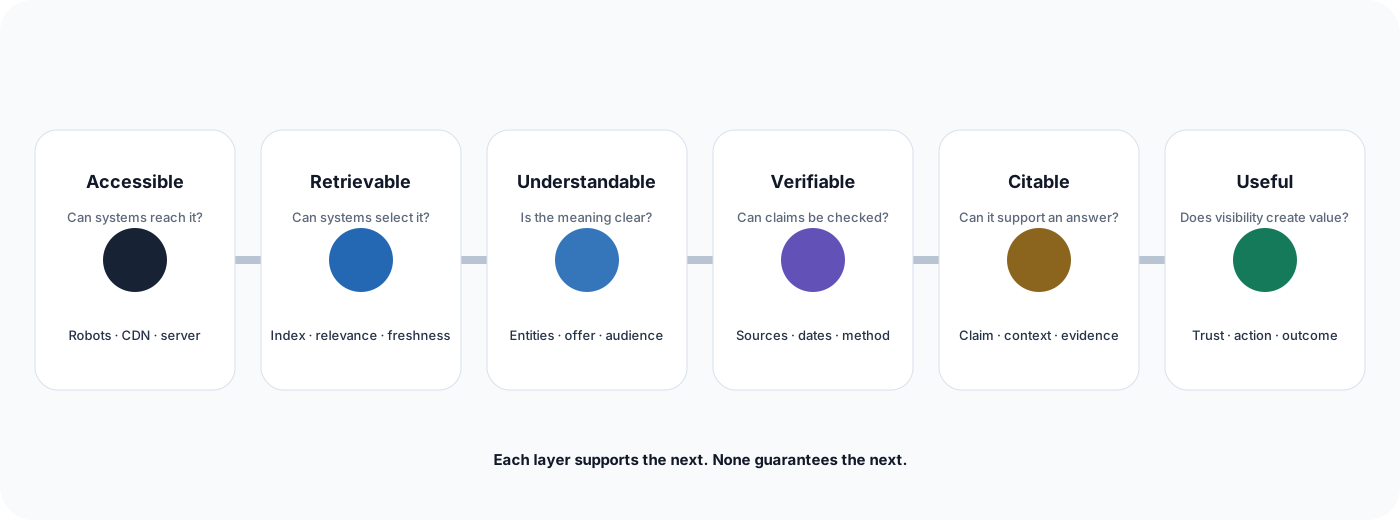
Layer 1: Accessible
Can the intended crawler, fetcher, or agent reach the public page through robots rules, hosting infrastructure, and the application?
This is the layer most directly observable through deterministic technical checks.
Layer 2: Retrievable
Can the page be discovered and selected by the search or retrieval systems supporting the answer experience?
OpenForBots can inspect some preconditions, but it cannot see a provider’s complete private index or ranking logic.
Layer 3: Understandable
Does the page clearly communicate what the organisation is, what it offers, who it serves, which facts matter, and how its entities and pages relate?
This includes visible text, headings, metadata, internal links, and structured data that agrees with the page.
Layer 4: Verifiable
Can important claims be checked against evidence?
Useful signals include primary sources, named authors, publication dates, methodology, original data, examples, definitions, and transparent limitations.
Layer 5: Citable
Can the system extract a self-contained passage that directly supports part of an answer?
A citable passage normally contains a clear claim, sufficient context, precise terminology, and evidence appropriate to the question.
Layer 6: Useful
Does the resulting visibility help a person make a decision or complete a task?
This is where discovery meets product quality, trust, conversion design, and customer value.
Where OpenForBots fits
Start with the layers you can inspect responsibly
OpenForBots evaluates crawler policy, public retrieval, business clarity, and evidence readiness. It labels what is observed, documented, simulated, inferred, or left for manual verification. It does not convert those findings into a fictional citation probability.
What AI-ready content should mean
“AI-ready” should not mean awkward prose written for machines or mass-produced pages designed to manipulate answer systems.
It should mean content that is useful to people and unusually easy for machines to interpret accurately.
Establish context early
Identify the subject, audience, problem, and outcome before using advanced terminology. Do not force a new visitor to reconstruct the category from product jargon.
State important facts explicitly
Do not hide the core offer, product category, location, pricing model, limitations, or methodology entirely inside images, interactions, or vague slogans.
Structure information around real questions
Use descriptive headings, direct definitions, examples, comparisons, and procedures. Complex user requests often contain several subquestions; strong sections can support those smaller retrieval tasks.
Publish original value
A rewritten summary of existing search results is unlikely to become durable evidence. Original research, tested workflows, first-party product details, transparent methodology, and genuine expertise create stronger reasons to retrieve and cite a page.
Show provenance
Where accuracy matters, identify the source, date, author, method, and limitations behind a claim.
Make passages self-contained
A paragraph should not depend on several missing sections to establish what its subject is. Clear local context improves reading and reduces the risk of extraction without meaning.
Keep machine-readable claims aligned with visible content
Structured data can clarify a page, but it should not describe facts users cannot see or verify.
How measurement is changing
Traditional SEO metrics remain valuable:
- indexed pages;
- impressions;
- rankings;
- clicks;
- conversions;
- crawl and performance data.
AI-mediated discovery adds emerging measurements:
- cited URLs;
- citation frequency across prompt sets;
- brand inclusion in generated comparisons;
- citation accuracy;
- referral traffic from AI products;
- which topics or intents produce citations;
- conversion quality from those referrals.
Microsoft’s Bing Webmaster Tools has begun exposing AI citation performance, showing that generative visibility is becoming a measurable layer rather than only an anecdotal observation.
Even so, measurement must remain conservative. Prompt results vary by wording, location, product, model, freshness, and time. A small benchmark can show observed behaviour; it cannot establish a permanent universal ranking.
What businesses should do now
The durable response is not to chase every new acronym. It is to strengthen the visibility stack in order.
1. Protect the search foundation
Confirm that important pages are crawlable, indexable, internally linked, technically reliable, and useful to their intended audience.
2. Review crawler purpose
Document which recognised agents are allowed or blocked and why. Separate search discovery, training, user-triggered retrieval, and data-use controls.
3. Publish the missing context
Before advanced tactical guides, explain the category, terminology, history, user problem, and limitations. A visitor should understand why the work matters before being asked to configure it.
4. Make the business understandable
State the organisation, product, audience, use case, differentiators, geography, and important supporting facts in accessible text.
5. Build evidence-bearing content
Publish primary documentation, original analysis, methodology, case studies, definitions, comparison frameworks, and source-backed guides.
6. Monitor several discovery surfaces
Use traditional search data alongside observed AI citations, referral traffic, prompt benchmarks, and citation quality.
7. Refuse false certainty
No technical change can guarantee that a private system will retrieve, cite, rank, recommend, or send traffic to a page. Treat unsupported “AI ranking scores” with the same caution as any other metric without a reproducible method.
The future is not SEO versus AI
The transition is best understood as a widening stack.
Traditional SEO asks:
Can a search engine find, index, and rank this page?
Modern semantic search also asks:
Can the system understand the subject, entities, intent, and quality of the page?
Generative discovery adds:
Can this page provide relevant, trustworthy evidence for an answer?
Agentic systems add:
Can a machine use the website reliably while helping a person complete a task?
These layers reinforce one another.
Strong technical SEO supports retrieval. Clear content supports understanding. Original evidence supports trust. Well-structured explanations support citation. Accessible product experiences support agent use. A useful product supports the final human decision.
The websites best prepared for this era will not abandon people to write for bots.
They will make valuable information exceptionally easy for both people and machines to access, understand, verify, and use.
That is the practical meaning of being open for bots.